Visual Mnemonics App for German Vocabulary
Keymagine is a visual mnemonics app for German vocabulary that connects German words to familiar English keywords, short cue sentences, and memorable images.
By Keymagine · Published
A German word can leave you with several things to remember: its meaning, its sound, its article, and its plural. A picture can give the meaning a clear anchor, leaving you a more concrete starting point for practising the rest. A shark waving hello, for example, gives you a way back to Hai through the English greeting hi.
Keymagine uses the keyword method to create that connection. It generates a familiar keyword, a sentence describing a scene, and a visible mnemonic image. It is a useful option when you want help remembering German vocabulary and would prefer ready-made visual associations to inventing every scene yourself. Use it alongside listening, reading, and a course or teacher for German grammar.
Four German words with visual memory hooks
Read the German word and its meaning first. Then connect the English keyword to the illustrated scene. These are examples from Keymagine's public vocabulary showcase; the article and practice sentence below add context for using each word.
der Hai
German
shark
English
hi
Keyword
Imagine a shark saying hi.

Hi is a close sound cue for Hai. Say der Hai as one unit when you recall the image; the picture alone does not teach the article.
Der Hai schwimmt.
The shark is swimming.
die Zitrone
German
lemon
English
sit throne
Keyword
Imagine a lemon sitting on a throne.

Sit throne is a loose mnemonic, not a pronunciation guide. Listen for the German z sound and the final syllable, then recall die Zitrone.
Die Zitrone ist gelb.
The lemon is yellow.
die Kartoffel
German
potato
English
cart full
Keyword
Imagine a cart full of potatoes.

The cart gives you a starting cue for Kartoffel. Check the whole word with audio rather than shortening it to the English phrase.
Ich koche eine Kartoffel.
I am cooking a potato.
die Birne
German
pear
English
burner
Keyword
Imagine a pear on a burner.
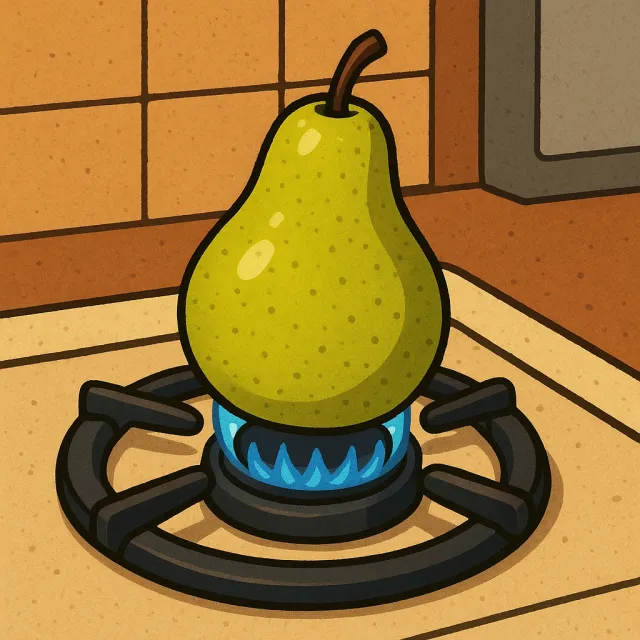
Burner is an approximate English hook for Birne. Keep the German pronunciation separate from the familiar English word.
Die Birne ist reif.
The pear is ripe.
Learn German articles and plurals with the word
Remembering potato is only part of learning Kartoffel. Practise die Kartoffel, die Kartoffeln together, and do the same for der Hai, die Haie; die Zitrone, die Zitronen; and die Birne, die Birnen. Notice that the plural article is die in each example, even though the singular article can differ.
If you make your own study notes, you can add a consistent symbol for each singular article to your mental scene. Treat that as an extra cue you supply, rather than assuming an image automatically encodes grammatical gender. When you test yourself, ask for the article and plural aloud as well as the English meaning.
Keep the memory hook separate from German pronunciation
A mnemonic only needs to remind you of a word; it does not need to reproduce every sound. This matters with Zitrone, where sit throne gives you an image but leaves important pronunciation details to learn. Listen to the word, repeat it, and return to the audio after looking at the image.
Write German nouns with their initial capital letter. As you encounter longer compound nouns, look up their parts before making an association: a familiar-looking piece can help, but guessing from English can also mislead. Use a dictionary to check meaning and grammar before committing a scene to memory.
A short German vocabulary routine
Start with a small group of words from your current lesson, a shopping list, or a passage you are reading. For each word, listen to the pronunciation, check the meaning, and look at the keyword and image. Explain the scene to yourself in one sentence so that the connection is clear.
Next, hide the meaning and try to retrieve it from the German word. Reverse the exercise by looking at the meaning and saying the German word with its article. Finally, use it in a simple sentence, such as Die Birne ist reif. The sentence checks something the picture cannot: whether you can place the word in actual German.
Return to the words on later days. If you remember the picture but not the word, strengthen the sound connection. If you recall the meaning but miss the article, practise the full noun phrase. Let your mistakes decide what to review rather than adding more words to a growing unfinished list.
When is a German visual mnemonic app a good fit?
Choose Keymagine if your main obstacle is remembering German word meanings and you want an app to generate the keyword, cue sentence, and image. Its focus is vocabulary. The illustrated examples let you check whether this kind of association makes sense to you before you build a study habit around it.
For conversation, case endings, word order, and listening comprehension, keep working with German in context. A mnemonic image can help you retrieve a noun; repeated reading, listening, and speaking help you use it without having to mentally revisit the scene every time.
Frequently asked questions
Which app uses visual mnemonics for German vocabulary?
Keymagine supports German vocabulary with AI-generated visual mnemonics. It connects a German word to a familiar keyword, a cue sentence, and an image. It is designed for vocabulary practice alongside other German learning activities.
Can visual mnemonics help me remember der, die, and das?
You can add an article cue to a mnemonic, but a picture of the meaning does not automatically encode grammatical gender. Practise the article with the noun, check it in a dictionary, and test the plural separately.
Can I learn German just by memorizing pictures?
Pictures can support vocabulary recall. Learning German also requires pronunciation, grammar, listening, reading, and speaking practice. Use the mnemonic as a bridge to recalling and using the word in a German sentence.
Sources and further reading
Try visual mnemonics for German
Explore Keymagine on iOS or Android.